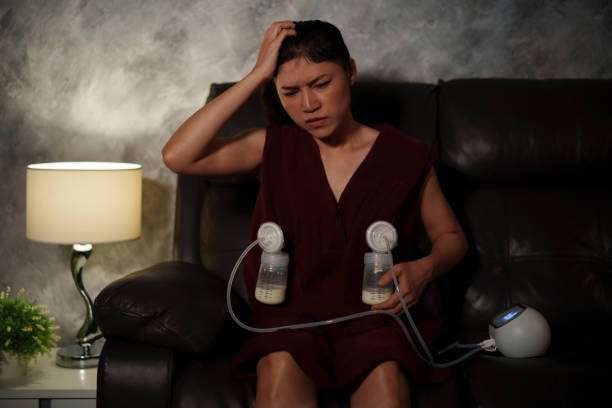
Many mothers, when using a breast pump for the first time, silently ask themselves, “Why is it so easy for others to use, but it hurts so much for me?”
Some people may even doubt whether they are “not suitable for breastfeeding,” whether their nipples are “too sensitive,” or simply believe that breast pumps are painful and that they can just bear it.
But to be honest, the pain of breastfeeding is never a “normal price to pay.”
The real problems often lie hidden in the small, overlooked details.

Breast Pumps Aren’t “Pain Generators,” But They Can Amplify Problems.
Let me start with a fact that many new mothers are unwilling to admit: they do not actively cause pain, but they can amplify existing problems infinitely.
In terms of how it works, a breast pump simply simulates a baby’s sucking rhythm, using negative pressure to stimulate the nipple and areola to help express milk. If your physical condition, usage method, and rhythm settings are all appropriate, most people will only feel a pulling or fullness sensation, rather than a stinging or burning pain.
If you feel pain, it means that at least one part of the process is wrong.
6 Core Reasons That Really Cause Pain When Pumping
Using Too Much Suction Is the Most Common and Easiest Mistake to Make.
This is the first pitfall I’ve personally fallen into.
I first started using a breast pump; my thinking was simple: “The stronger the suction, the more milk I produce, and the more efficient it is.”
And what happened?
In less than 3 minutes, the nipples started to feel numb and tingly and even turned a little white.
The fact is:
- Excessive suction can directly compress the nipple nerves.
- Forcibly pulling on the mammary ducts can actually hinder the smooth flow of milk.
- The body will instinctively produce a “defense response,” which will actually slow down lactation.
A breast pump doesn’t produce milk by “sucking hard,” but rather by “rhythm + relaxation.”
Mismatched Breast Pumping Rhythm Is More Fatal Than the Amount of Suction.
Many mothers only focus on the “gear” but ignore the rhythm.
During actual breastfeeding, a baby will experience:
- Quick, shallow sucking (to stimulate milk let-down)
- Stable, deep suction (continuous milk production)
- Intermittent adjustment
However, if the breast pump starts with a single, mechanical, and continuous high-frequency rhythm from the beginning, the nipples can easily become fatigued, and pain will follow.
Especially:
- Entering strong sucking mode before milk even comes out
- The stimulation period is too short.
- No transition phase
All of these will cause the body to “fall behind the machine.”
If the Flange Is the Wrong Size, Pain Is Almost Inevitable.
This is a point that many people underestimate, yet it is extremely crucial.
If the breast pump’s flange:
- Too small: The nipple is squeezed and rubbed.
- Too large: The areola is pulled in excessively, causing pulling pain.
All of these can directly cause pain and may even lead to:
- Nipple redness and swelling
- Minor abrasions
- Continuous stinging after inhalation
After I changed to a properly sized flange, the pain almost immediately decreased by more than half.
The nipple itself is already damaged, but it is being ignored.
Consider these scenarios when using a breast pump:
- The baby’s latch was incorrect and has already bitten the nipple.
- Frequent nighttime feedings can cause nipple fatigue.
- Dryness and peeling without timely repair
Using a breast pump in this state is like repeatedly pulling on already injured skin.
Pain isn’t you being dramatic; it’s your body sending a warning signal.

Physical tension and stress can directly “create pain.”
Many people don’t believe this, but it’s absolutely true.
When you:
- While pumping breast milk, I checked the time.
- Worried about milk supply
- Disturbed by sound and environment
The body will be in a state of mild stress, oxytocin secretion will decrease, and milk flow will be obstructed. The breast pump continues to work, but the negative pressure is not “responded” to, and the pain will naturally be amplified.
I clearly felt several times that the more anxious I was, the more it hurt, but when I relaxed, it went smoothly.
Using a Breast Pump for Too Long, Exceeding the Body’s Tolerance.
Many mothers inhale for 30-40 minutes at a time in order to “inhale more.”
But in reality:
- The breasts complete their primary emptying within the first 15–20 minutes.
- The latter half involves more mechanical stimulation of the nipple.
Prolonged use of a breast pump for extended periods can easily lead to:
- Nipple engorgement
- Nerve sensitivity
- The pain worsened the next day when breastfeeding.
How Can You Determine If Your Breast Pumping Pain Is “Normal”?
We can use a simple standard to judge:
Normal sensations: pulling, swelling, and slight discomfort, but tolerable.
Abnormal pain: tingling, burning, numbness, persistent pain after suction
If the latter occurs, it means that the way the breast pump is used or its condition needs to be adjusted.
To Reduce Breast Pump Pain
- Start with the lowest suction level to give your body time to adjust.
- First stimulate the milk let-down reflex, then proceed with stable breastfeeding.
- Confirm that the flange size is appropriate.
- Apply a warm compress for 2–3 minutes before pumping.
- Limit single-use time to within 20 minutes.
- Give the nipples enough time to heal.
These methods may seem simple, but they are key to truly reducing breast pump pain.
FAQ
Q1: Will it always hurt more than when the baby latches on?
Not necessarily. With proper breast pump settings, the pain can be significantly less than the stimulation from incorrect latching.
Q2: Does pain indicate a poor-quality breast pump?
Not entirely. Much pain comes from how it’s used, not from the breast pump itself.
Q3: Will I gradually get used to it if I just endure the pain while pumping?
It’s not recommended. Enduring pain for a long time can easily cause nipple damage and even affect lactation.
Q4: My breast pump isn’t pumping milk. Should I increase the suction power?
In most cases, no. Relaxing and adjusting your rhythm are often more effective than increasing the suction power.
Q5: Are breast pumps unsuitable for people with sensitive nipples?
No. Sensitive nipples actually require proper settings and size, rather than giving up on using them altogether.
Summarize:
A breast pump is meant to be a tool to help mothers reduce their burden, not a new source of stress.
If you are experiencing breast pumping pain, please remember this: the pain is not your problem, but rather that your method needs to be adjusted.
When you truly understand the working logic of a breast pump and get your body and machine to “cooperate,” breast pumping will be much gentler than you imagine.
If you’re looking for a breast pump with controllable suction, a rhythm closer to your baby’s, and that’s more nipple-friendly, check out our products designed for the real needs of new mothers.