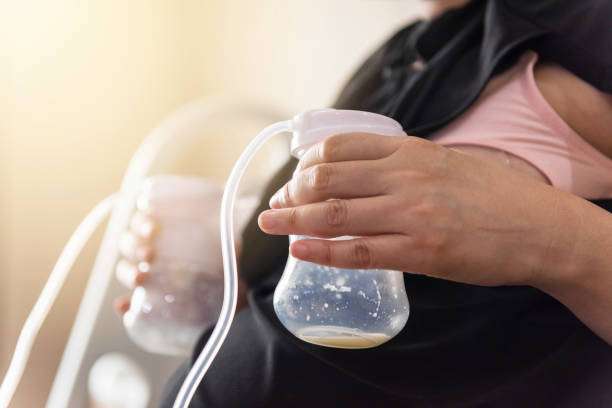
On the journey of breastfeeding, mothers often struggle to persevere while being surrounded by various anxieties.
One frequently asked question is, will long-term use of a breast pump affect a baby’s sucking ability or even make the baby unwilling to nurse properly?
Behind this question lies the dilemma of many mothers—wanting to ensure breast milk supply while fearing they might “do more harm than good.”
Especially during periods of returning to work, frequent nighttime feedings, nipple pain, or an imbalance between supply and demand, breast pumps become almost a daily routine, but this also brings new anxieties.
How is a baby’s sucking ability established and developed?
To answer this question, we must first understand one thing: a baby’s sucking ability is not determined by “whether or not to use a breast pump,” but by a gradual physiological and neurological process of maturation.
Sucking is not a single action but a complex and coordinated process.
When breastfeeding a baby, the following should be done simultaneously:
- Lip seal
- tongue wraps around nipple
- The jaw moves rhythmically.
- Swallowing and breathing coordination
This is a highly delicate process, especially in the first few weeks after birth, during which it develops and strengthens rapidly. As long as the baby has enough opportunities to directly suckle at the mother’s breast, this ability usually does not easily “fade away.”
Will the breast pump itself weaken the baby’s sucking ability?
The answer is not simply “yes” or “no.”
The breast pump is not the problem itself; the key issue is whether it completely and consistently replaces the baby’s direct sucking.
A breast pump is not a substitute for breastfeeding.
A breast pump works by stimulating the breasts with negative pressure to produce milk. It does not mimic a baby’s complete sucking pattern, nor does it “teach” the baby incorrect sucking techniques.
Therefore, simply using a breast pump will not directly cause a decrease in the baby’s sucking ability.
The following situations are what we really need to pay attention to.
In what situations might a baby’s sucking ability be affected?
The baby rarely nurses directly.
If the baby receives breast milk mostly through a bottle and rarely breastfeeds directly, then:
- Insufficient practice of sucking action
- Reduced stimulation of oral muscles
- The proficiency in breastfeeding may decrease.
This isn’t a problem with breast pumps but rather a problem with “reduced practice opportunities.”
Improper bottle-feeding method
Some babies may experience the following after frequent bottle feeding:
- Sucking becomes shallower
- The breast is not deeply in the mouth
- Decreased patience with breastfeeding
This is often mistakenly attributed to the breast pump, but it is actually more related to the bottle flow rate being too fast or improper feeding posture.
Premature and excessive reliance on tools led mothers to reduce breastfeeding.
A breast pump can indeed relieve a lot of stress when you have nipple pain, are tired, or are short on time. However, if you use it to completely replace breastfeeding, the reduced sucking interaction between the baby and mother may indirectly affect the consolidation of sucking ability.
So why do many mothers “feel” that their baby’s sucking has become worse?
This feeling is very real and very common.
For a period of time, after frequently using a breast pump at night, when it came time to breastfeed, the baby seemed more impatient and irritable, as if less willing to put in the effort to suckle slowly.
This is not a sign of the baby “regressing,” but rather a difference in how the baby adapts to different feeding methods, causing anxiety for the mother.
The baby hasn’t learned to “be lazy,” but rather has become more sensitive to flow rate and feedback.
Using a breast pump correctly can actually “protect” your baby’s sucking ability.
When used correctly, a breast pump is not an adversary but rather an important support tool for breastfeeding.
- Breastfeeding should be the priority when possible.
- a breast pump to maintain milk production when breastfeeding is not possible.
In this mode, the baby’s sucking practice is not deprived.
Maintain a certain proportion of direct breastfeeding.
a breast pump Frequently, it is recommended to allow your baby to suckle directly a few times a day to help them develop oral and sucking coordination skills.
Combined with “slow flow” bottles and rhythmic feeding
This can reduce the baby’s dependence on a fast flow rate and avoid the situation of “not being patient with breastfeeding.”
A breast pump for a mother goes beyond simply “expressing milk.”
Many mothers rely on breast pumps because they play so many roles in real life:
- Maintaining breast milk supply
- Relieve breast engorgement discomfort
- Helping mothers find a balance between work and childcare
When the body is already very tired, breastfeeding may be discontinued earlier without a breast pump. In the long run, a stable and continuous supply of breast milk is beneficial to the long-term development of the baby’s sucking ability.
FAQ: Some of the most frequently asked questions by mothers
Q1: If I keep using a breast pump, will my baby refuse to breastfeed later?
A: As long as you don’t completely stop breastfeeding and pay attention to the bottle-feeding method, most babies will not refuse breast milk.
Q2: Will using a breast pump during the day and breastfeeding at night affect the baby?
A: This method is very common and has little impact on the baby’s sucking ability. On the contrary, it can help mothers maintain breast milk supply.
Q3: My baby cries after a few sucks. Is it because I’ve been using the breast pump too much?
A: Not necessarily. It could be related to the flow rate, position, gas, or mood. It can’t be simply attributed to the breast pump.
Q4: How long is considered “overuse”?
A: Feeding methods should only be reassessed when it has almost completely replaced direct breastfeeding and has continued for more than several weeks.

Summarize:
Breastfeeding is never a standardized multiple-choice question. Breast pumps are not a “good” or “bad” label but rather a tool to help mothers go further.
If you’re looking for a breast pump that’s comfortable, has a rhythm similar to a baby’s sucking, and is suitable for long-term use, consider a model that fits the body better, is quieter, and has gentler suction.